
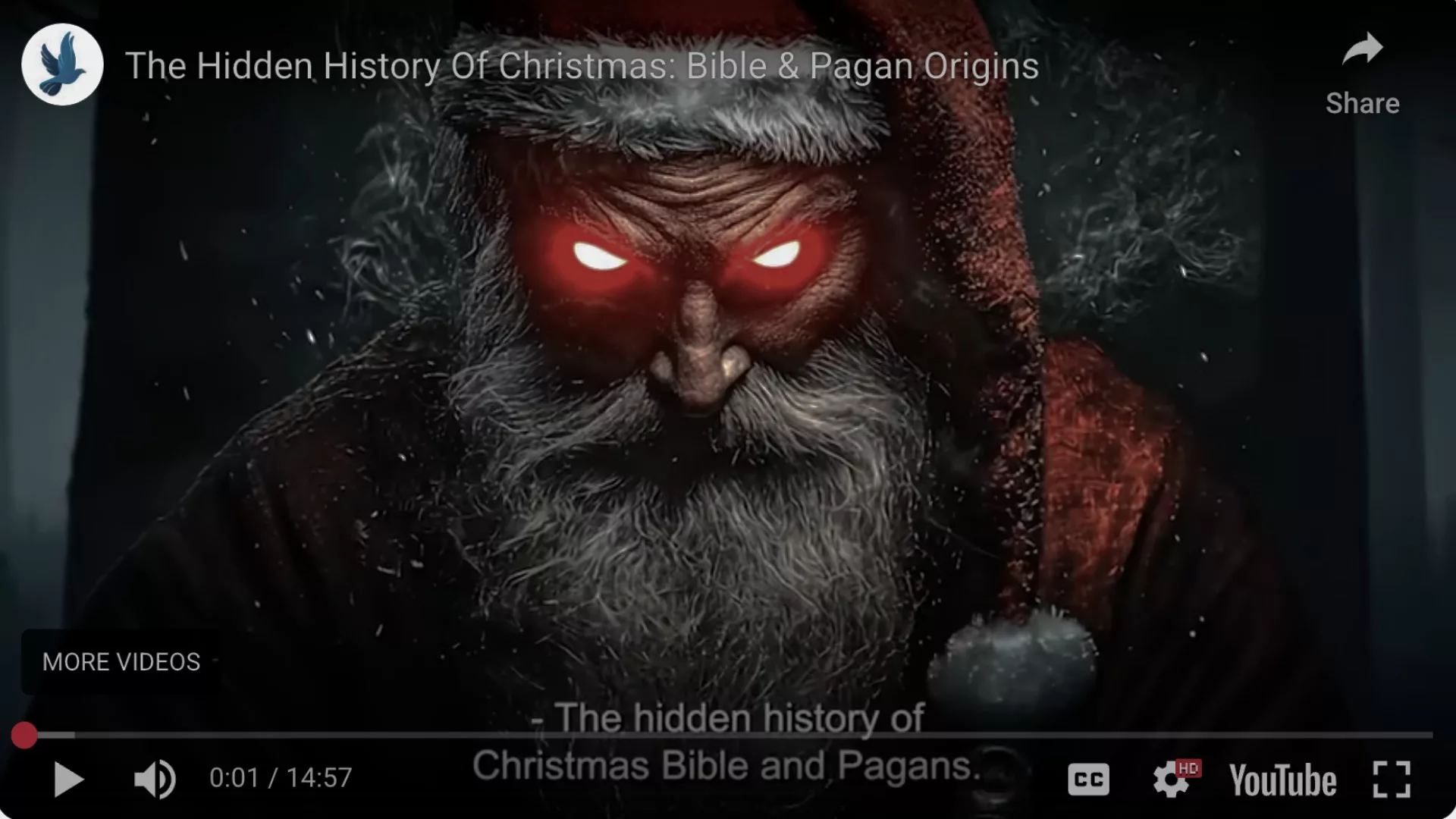

Searching for the History of Christmas? For centuries, December 25th has been globally celebrated as the day of the Messiah’s birth. But what if we told you that the date itself—and many of our most cherished traditions—are steeped in a hidden history that is far from Christian?
For believers dedicated to truth, understanding the pagan roots of Christmas is not about rejection, but about claiming a history of powerful redemption. This deep dive into the archives reveals the astute strategy the early church employed to turn winter’s darkest, most indulgent festivals into a light-bearing celebration of the Son of God.
Unmasking the Origins of December 25th
The video explains that to understand Christmas, we must travel back in time, long before the birth of Christ, to a cold and harsh ancient Europe.
The selection of December 25th was a masterstroke of spiritual warfare by the early church, designed to confront deeply entrenched pagan customs by giving them a radical new meaning.
- The Yule Festival: In northern Europe, the celebration of Yule marked the winter solstice—the darkest night of the year. People lit massive bonfires to honor the sun and kept enormous Yule logs burning, symbolizing light overcoming darkness.
- Saturnalia: In the Roman South, the midwinter festival of Saturnalia was a full-blown carnival dedicated to Saturn, the god of Agriculture. During this time, social norms were flipped, and the streets were filled with feasting, laughter, and—significantly—gift-giving.
- Sol Invictus: The date was also later linked to the Roman festival of Sol Invictus (the Unconquered Sun), which celebrated the return of longer days after the winter solstice.
Historically, the Bible gives clear clues, such as the shepherds watching their flocks in the fields, which suggest Yeshua was likely born in the spring or fall, as the weather in Judea in December would have been too cold and often snowy. The date was not chosen for accuracy but because it was strategically close to the time when these pagan festivals were already in full swing.
The Dangerous Customs the Church Sought to Redeem
The most compelling part of this hidden history is the customs that were adapted. These ancient celebrations were not quiet observances; they were times of excess and indulgence:
- Chaos and Misrule: The celebrations often got wild, where self-control was forgotten. Drinking was excessive, gambling was common, and a “lord of misrule” was elected to encourage everyone to let go of their inhibitions for 12 days. This concept of a topsy-turvy world is the root of the “Twelve Days of Christmas”.
- Fertility Symbols: Many decorations, such as evergreens, holly, and mistletoe, were ancient symbols of life and fertility during the bleakest time of the year. The popular custom of kissing under the mistletoe is, according to the video, an echo of these ancient fertility customs.
In the early centuries, most Christians refused to celebrate these festivals, viewing them as indulgent and “completely opposed to the teachings of Christ”.
The Defiant Act of Transformation
The shift in practice came about as a strategic mission to convert Europe. Missionary Augustine, sent to convert local people, realized they were too deeply attached to their midwinter festivals to give them up.
Pope Gregory’s controversial response changed everything. Instead of demanding abandonment, he suggested transformation, essentially saying, “If you can’t beat them, join them”.
In this courageous decision, Pope Julius officially declared December 25th as the date for Christ’s birth. The church leaders assigned a Christian meaning to the pagan symbols:
- The Yule Log came to represent Christ as the light of the world.
- Evergreens symbolized the eternal life found through Yeshua.
- The celebration of the Unconquered Sun was reinterpreted as the celebration of the Son of God, the True Light of the World.
A Crucial Question for Believers Today
This history of conflict and controversy continues today, but the church’s ultimate aim was to plant a new narrative: Christ’s birth represents the hope that dispels despair, the light that overcomes darkness.
For us, the powerful lesson lies in our conviction. We are not commanded to participate in every Christian tradition, but we are commanded to honor the Lord with our whole heart.
The Scriptures teach a principle of conscience: what we choose to focus on is everything.
“One person considers one day more sacred than another; another considers every day alike. Each of them should be fully convinced in their own mind.” — Romans 14:5 (CJB)
Whether you embrace the traditions or abstain from them, the defining question is whether your focus remains solely on the Son of God, the Messiah, and the True Light of the World.
By Philip Pearson
(Video: The Hidden History Of Christmas: Bible & Pagan Origins, via Grace Digital Network)



Leave a Reply