
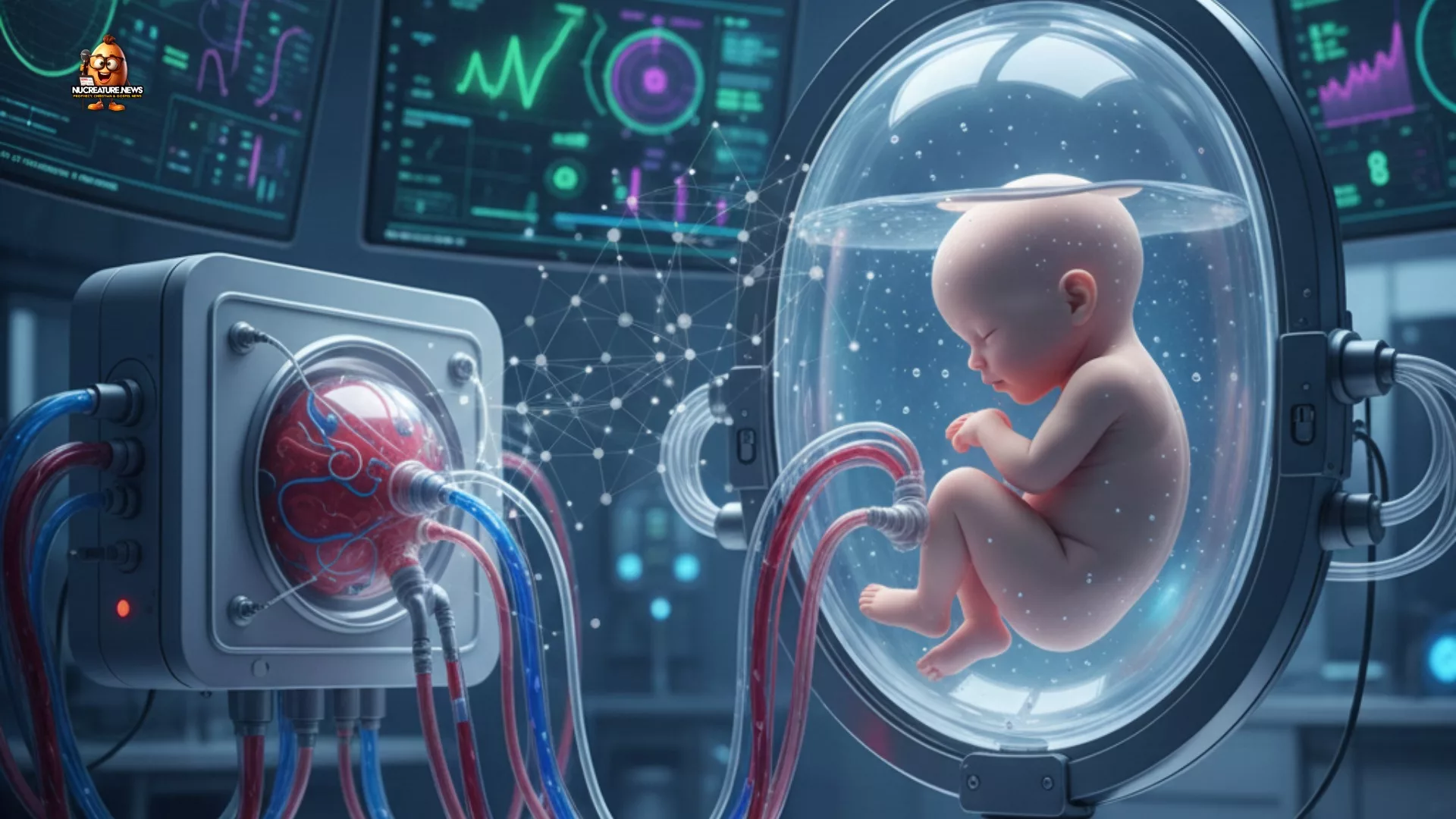

Researchers in Japan have unveiled a groundbreaking advancement in reproductive technology: the world’s first fully functional artificial womb system or ‘BioBags’. While experiments with “biobags” have been seen in the past, this latest development from Juntendo University and Tohoku University represents a paradigm shift in how we conceive the beginning of life.
For decades, the “border of viability” for premature infants—roughly 22 to 24 weeks—has been a wall that medical science struggled to scale. Now, Japanese scientists have effectively “broken the 4-minute mile” of neonatal care, creating a synthetic environment that doesn’t just incubate a baby but mimics the maternal uterus with eerie precision.
Artificial Womb: Mastering the “Artificial Placenta”
The technology, often referred to as EVE (Ex-Vivo Uterine Environment), is far more than a high-tech incubator. It is a translucent, fluid-filled sac that replicates the amniotic environment. Unlike traditional ventilators that can damage fragile, undeveloped lungs, this system allows the fetus to “breathe” through an artificial placenta.
Using an external circuit, the system handles oxygenation and nutrient delivery while simultaneously removing waste—mimicking the complex exchange of a real umbilical cord. AI-assisted monitors track heartbeats and fetal motion in real-time, adjusting the synthetic amniotic fluid’s pressure and temperature to ensure a seamless transition from biology to machine.
Artificial Womb: How the Church Should Respond
As we cover this at NuCreature News, we must look beyond the gleaming labs and address the profound spiritual and ethical questions this technology raises. While the medical promise for saving thousands of micro-preemies is undeniable, the prospect of “ectogenesis”—gestating life entirely outside the human body—challenges our traditional understanding of the “living soul.”
The scripture reminds us of the intimate involvement of the Creator in the womb:
“For you fashioned my inmost being, you knit me together in my mother’s womb.” (Tehillim [Psalms] 139:13, CJB)
As we move toward a world where the “knitting together” can happen in a bioengineered capsule, the Church and the scientific community must engage in a rigorous dialogue about the sanctity of life and the definition of motherhood.
The Road Ahead: Hope or Hubris?
While concept videos like “EctoLife” have sparked viral (and sometimes misleading) debates about “baby farms,” the reality in Japan is focused squarely on clinical survival. Regulatory bodies, including the FDA, are now weighing the safety and ethics of human trials.
This innovation could democratize birth for those struggling with infertility or medical complications, but it also risks becoming a tool of commodification. As we watch this technology unfold, we are reminded that while man may build the vessel, the breath of life remains a divine mystery.
Stay tuned to NuCreature News for further updates on how technology is reshaping the Gospel’s reach in the 21st century.
While there isn’t a single “Hollywood-style” trailer for a real facility, there are several significant video reports and technical demonstrations that show this technology in action.
Where to Watch the Artificial Womb Technology
“AquaWomb” & Neonatal BreakthroughsRecent 2025 reports highlight the “AquaWomb” and the critical 3-minute window doctors have to transfer a fetus into the system. This video shows the specialized “transfer bags” used to move a baby from a mother’s womb into the synthetic one without letting them take a breath of air.
What to Look For in the Footage
When watching these for your blog research, pay attention to:
- The “Biobag” Clarity: Unlike a dark natural womb, these are clear, allowing doctors (and AI) to monitor development visually.
- The Umbilical Connection: You’ll see a complex “external circuit” where the blood is oxygenated. This is the “artificial placenta” mentioned in the article.
- The Fetal Movement: In the real scientific videos, you can see the fetuses (mostly lambs or goats in current trials) “swimming” and “dreaming” in the fluid, which is a powerful visual for your readers.
Sources:
- Juntendo University Research Division, “Ectogenesis and the Future of Neonatal Care,” 2025.
- The Japan Times, “World’s First Artificial Womb Milestones,” September 2023/May 2025.
- Tohoku University Hospital, “EVE Therapy Project: Breaking the Viability Barrier,” 2024.
- Complete Jewish Bible (CJB), David H. Stern.

Leave a Reply